Multiple instructions could compete with one another or be difficult to remember.
← HealthTech product ecosystem
Case 05 · Visualization · Clinical communication
Turning a complex prescription into a plan patients can follow.
I designed the bridge between clinical decisions and patients’ daily lives: a therapeutic strategy that physicians can review and sign, then transform into consistent instructions, schedules and documents.
From consultation to everyday action
Treatment does not end when the physician makes a decision.
In functional medicine, a strategy may combine medication, supplements, nutrition, habits, tests and follow-up. Clinical precision is essential, but it does not guarantee that patients understand what to do each day.
The HealthTech product needed to preserve the depth of the prescription while translating it into an experience that was clear, consistent across channels and ready to support adherence.
02 / Problem
The core tension
Information needed to be simplified without distorting clinical intent.
The platform and its documents could not present different versions.
Only the professional could confirm and sign a prescription.
The plan needed to remain useful after the consultation ended.
Design questionHow might we turn complex clinical decisions into understandable actions without losing precision, traceability or professional control?
My work
I designed one structure capable of supporting both the plan and its documents.
I organized the strategy by intervention type, purpose, instruction, schedule, duration and relationship to other actions.
I defined editing, review, alerts, validation, signing and document generation as one continuous sequence.
I transformed the validated plan into a daily view that prioritizes what to do now without hiding the full context.
I connected the prescription, orders, summary and therapeutic plan to one approved source to prevent duplication and inconsistencies.
I documented states, permissions, required fields, versioning, signatures and document-regeneration rules.
From decision to delivery
Four moments connect clinical precision with everyday understanding.
Organization may be assisted, but no output is treated as final until the professional reviews and validates the complete strategy.
Clarity without losing control
The system reduces duplication and makes responsibility visible.
One source, multiple outputs
The validated strategy feeds the daily view, prescription, orders and summary, reducing inconsistencies between documents.
The day as a unit of understanding
Patients can see what to do and when while retaining access to the complete clinical explanation.
Review before signing
Conflicts, incomplete data and assisted content appear before final documents are generated.
Precision without cryptic language
The wording preserves medical instructions while adding hierarchy, context and microcopy to support understanding.
Three layers of the same strategy
One validated decision adapts to the purpose of each output.
A complete view for reviewing instructions, relationships, alerts, signature and authorship.
A plan organized by time of day, with clear instructions and accessible context.
Prescription, orders and summary generated from the approved strategy.
Exploration for thinking and communication
Two views explored how to preserve judgment, traceability and understanding.
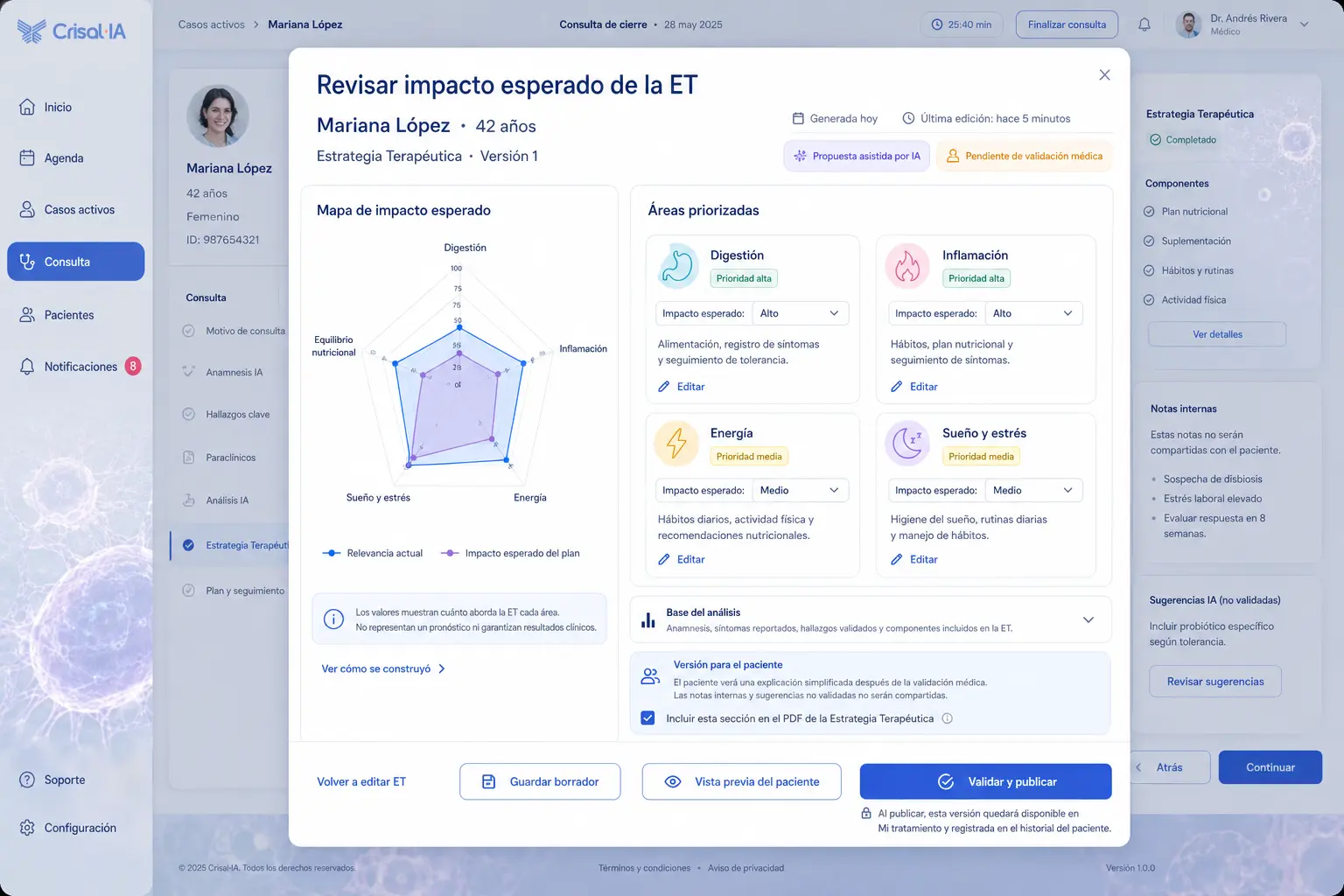
These proposals supported discussion about the transition from evaluation to strategy and document. Later refinement reduced components and prioritized the minimum sequence required to validate, sign and communicate the plan.
 Open larger image ↗
A visualization connecting findings, priorities and strategy without presenting the graphic as an automated diagnosis.
Concept exploration · UX/Product direction · AI-assisted visualization08 / Tools
Tools tied to decisions.
- Figma
- Flows, wireframes, UI, prototypes and components.
- FigJam
- Treatment model, relationships between outputs and update scenarios.
- ChatGPT + GenAI
- Case exploration, microcopy and organizational variations.
- FAIR-AI
- Authorship, human oversight, traceability and assistance boundaries.
- Functional definition
- Rules, states, permissions, exceptions and handoff.
09 / Outcome
Verifiable design outcomes
A coherent therapeutic system from prescription to routine.
- A unified model for strategy, daily view and documents.
- An explicit editing, review, validation and signing flow.
- Information hierarchy adapted to physicians and patients.
- Reusable patterns for different intervention types.
- Functional rules that preserve traceability and document consistency.
The product remains in development. These are design and definition outcomes; understanding, adherence and error reduction must be verified with users and usage data.
What this case reinforced
A strong therapeutic strategy does more than preserve a medical decision: it helps that decision survive the context of daily life.
The next validation should test the level of detail each patient needs, where doubts or abandonment occur and how treatment changes can be presented without breaking continuity or trust.
Next case
Clinical Follow-up and Continuity.
Helping physicians recognize priorities and quickly recover the context of each patient.