Information arrived from different modules and moments in the journey.
← HealthTech product ecosystem
Case 06 · Prioritization · State management
Maintaining continuity without forcing physicians to reconstruct every history.
I designed an experience that turns scattered signals into understandable priorities, preserves context and brings the next action closer, so clinical follow-up does not depend on memory or starting from scratch.
Care continues after the consultation
Cases change even when physicians are not inside the medical record.
Between consultations, lab results, patient responses, intake information, requests and tasks awaiting validation may arrive. Each signal has a different origin and importance, yet all compete for professional attention.
The HealthTech product needed to bring this activity together without creating noise, help recover context and sustain continuity between consultation, treatment and follow-up.
02 / Problem
The core tension
Staying informed should not mean becoming overwhelmed.
Not everything new required the same urgency or type of action.
Acting safely required understanding what changed and where it came from.
The system needed to show who should act without making a clinical decision for them.
Design questionHow might we help physicians identify what needs attention, recover context and act safely without reviewing every complete history?
My work
I designed a system of signals, states and actions to sustain continuity.
I defined what turns an update into an active case and how patient, event, priority, state and owner relate.
I organized incoming work by attention need, time and task type, with enough information to decide where to start.
I designed summaries for quick orientation and access to the original source when greater depth is needed.
I brought review, response, signature, data requests and follow-up into the case context through consistent patterns.
I documented priority rules, transitions, owners, closure, reopening and limits for assisted suggestions.
From a signal to a traceable action
Four moments reduce orientation time without reducing judgment.
Priority acts as operational support. Professionals can review and change it, then decide whether a signal requires clinical action, administrative follow-up or no further step.
Less noise, more orientation
The design makes visible what changed, who acts and what comes next.
Priorities, not an endless list
The inbox answers what needs attention now and separates open work from information-only updates.
Context before action
Summaries show origin, date and reason so professionals can understand each signal without losing traceability.
States that guide
Pending, under review, waiting for patient and resolved make visible who needs to act and what blocks progress.
AI with explicit limits
AI groups and summarizes information; clinical interpretation, final priority and action remain under professional control.
Three levels for context-aware decisions
Information appears at the depth each moment requires.
Patient, reason, age, status and next action are visible without opening the case.
A summary of changes, related tasks, sources and recent progress.
A situated response or validation with owner, confirmation and traceability.
Exploration for thinking and communication
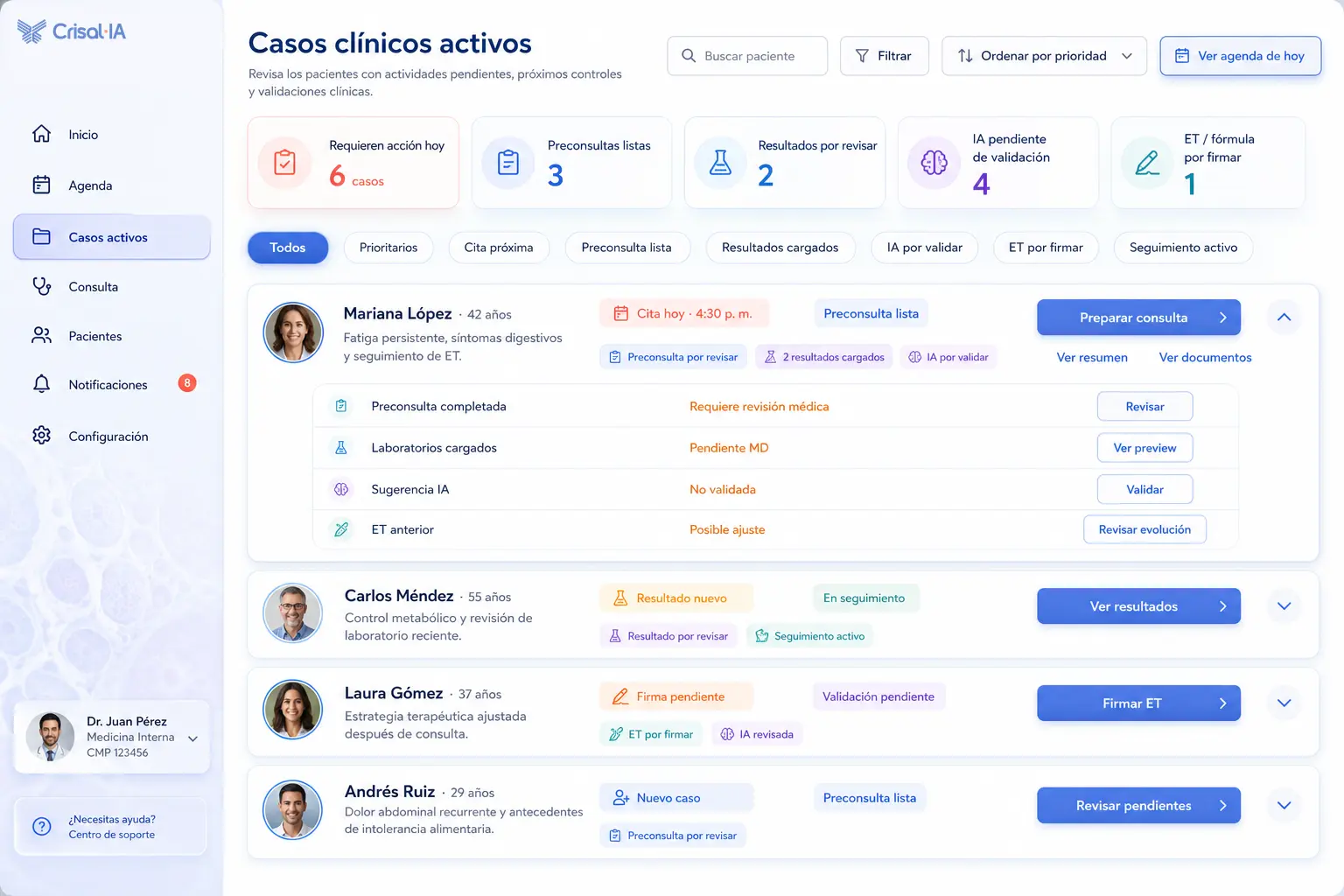
Continuity was explored from both the inbox and the context of each case.
The proposals compared two levels of depth: recognizing priorities without opening every history and recovering the thread when action was needed. The later MVP focused on essential signals and actions.
 Open larger image ↗
An exploratory inbox organizing signals, states and owners without forcing professionals to review every complete history.
Concept exploration · UX/Product direction · AI-assisted visualization08 / Tools
Tools tied to decisions.
- Figma
- Flows, wireframes, UI, prototypes and components.
- FigJam
- Mapping signals, owners, transitions and follow-up scenarios.
- ChatGPT + GenAI
- Edge-case exploration, microcopy and summary alternatives.
- FAIR-AI
- Transparency, oversight, traceability and assisted-prioritization boundaries.
- Functional definition
- Rules, states, permissions, exceptions and handoff.
09 / Outcome
Verifiable design outcomes
An operational foundation for sustaining the relationship between consultations.
- A unified model of signals, priorities, states and owners.
- A clinical inbox organized around attention needs.
- Traceable summaries for progressive context recovery.
- Consistent actions connected to each case state.
- Functional rules for closure, reopening and human oversight.
The product remains in development. These are design and definition outcomes; response times, prioritization accuracy and operational load must be validated through real use.
What this case reinforced
Continuity is not about showing more information. It is about preserving the thread of what changed, what matters and what needs to happen next.
The next validation should observe whether professionals interpret priorities correctly, how much context they need before acting and which signals create noise or excessive trust in AI assistance.
Complete ecosystem
Six product problems, one continuous clinical experience.
This case completes the HealthTech product series, from MVP architecture to the follow-up that sustains care over time.