The interface could not compete with the physician–patient conversation.
← HealthTech product ecosystem
Case 04 · Human–AI interaction · FAIR-AI
Designing clinical assistance without handing decisions to AI.
I defined an experience in which AI captures, organizes and suggests during the consultation while physicians can trace, correct and validate every output before it becomes confirmed clinical information.
Less documentation, more attention
AI could relieve operational work, but it could also introduce a new risk.
During a consultation, physicians listen, ask, interpret and document at the same time. The HealthTech product sought to reduce that load through transcription, automatic organization of the medical record and contextual suggestions.
Without a carefully designed experience, generated output could be mistaken for a fact, decision or validated recommendation. The challenge was to make assistance useful without hiding uncertainty or displacing professional responsibility.
02 / Problem
The core tension
Automation needed to save time without manufacturing authority.
Transcription and interpretation could include omissions or errors.
It needed to be clear what the patient reported, AI organized and the physician confirmed.
No clinical suggestion could be incorporated without professional review.
Design questionHow might we use AI speed without making a suggestion appear to be a clinical decision?
My work
I turned AI boundaries into visible interaction rules.
I separated capture, organization, suggestion and validation so the system could not jump directly from conversation to conclusion.
I defined how to distinguish reported information, transcription, generated content and confirmed data.
I designed patterns to review, edit, accept, discard, return to the source and flag insufficient information.
I incorporated incomplete audio, contradictions, low confidence, interruptions and suggestions requiring human escalation.
I documented traceability, permissions, persistence and boundaries for MVP implementation.
From conversation to reviewed decision
Four states prevent automation from erasing responsibility.
Information changes state only through an explicit action; AI never automatically turns an inference into a confirmed part of the medical record.
Human oversight built in
Safety does not live in a warning; it lives in every interaction.
States that cannot be confused
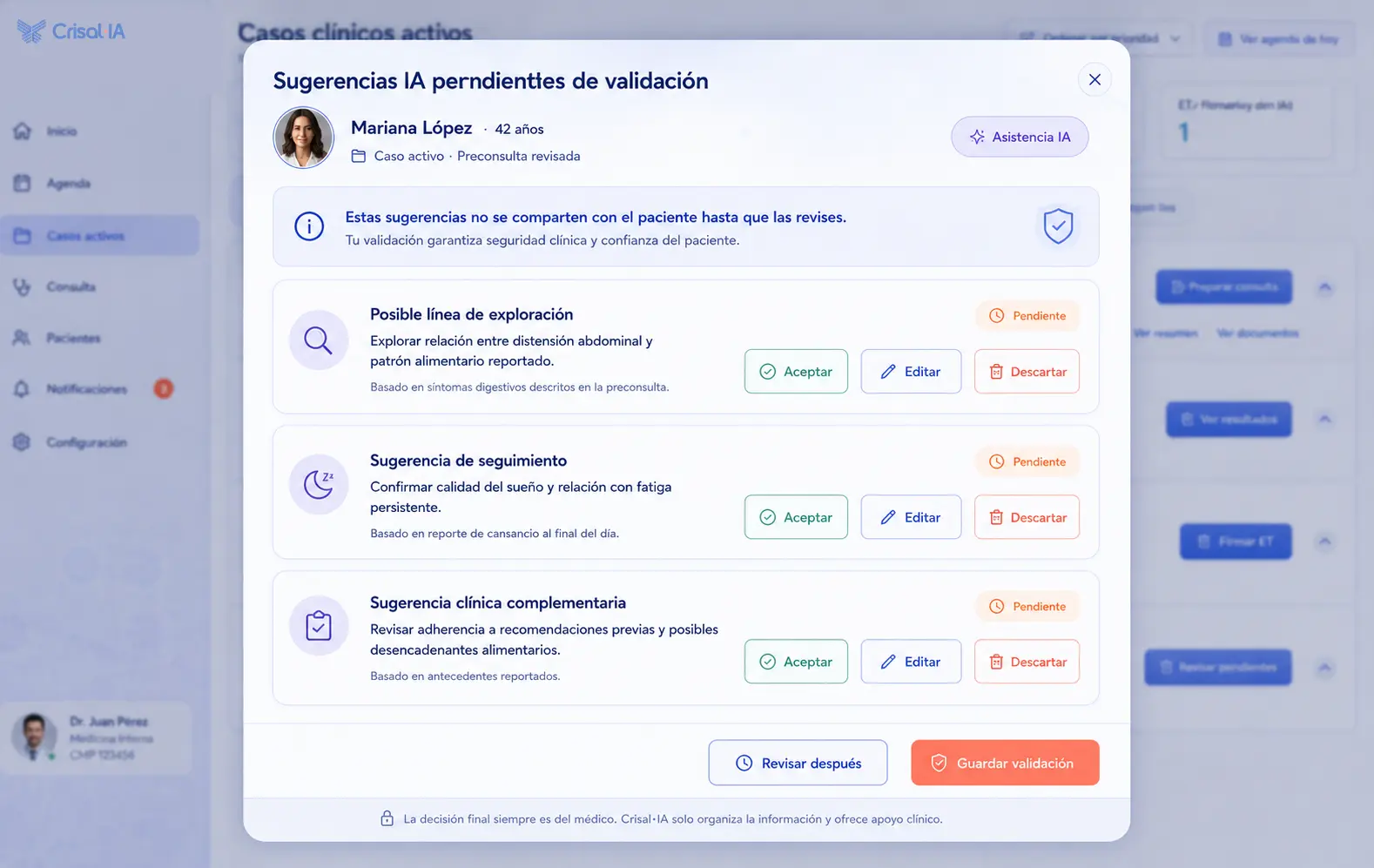
The interface distinguishes transcription, AI-organized content, pending suggestion and professionally confirmed decision.
Source always available
Every summary or data point can be traced to the conversation fragment or information that produced it.
Validation inside the flow
Editing, accepting or discarding happens where the suggestion appears rather than in a separate review at the end.
Exceptions before automation
The experience covers uncertainty, contradictory information, capture failures and cases that need to stop or escalate.
FAIR-AI applied to the interface
Three safeguards make assistance understandable and reversible.
Labels and states show when the system transcribed, organized or suggested content.
The original source remains available to verify any summary or proposal.
The professional can edit, reject or validate, and the action is recorded.
Exploration for thinking and communication
Assistance was designed around review, decision and professional authorship.
The images made visible the points where AI needed to stop and return control. The final solution was refined to retain only the highest-value aids within the MVP timeframe.
 Open larger image ↗
Every proposal remains pending until the professional accepts, edits or discards it; the decision is never automated.
Concept exploration · UX/Product direction · AI-assisted visualization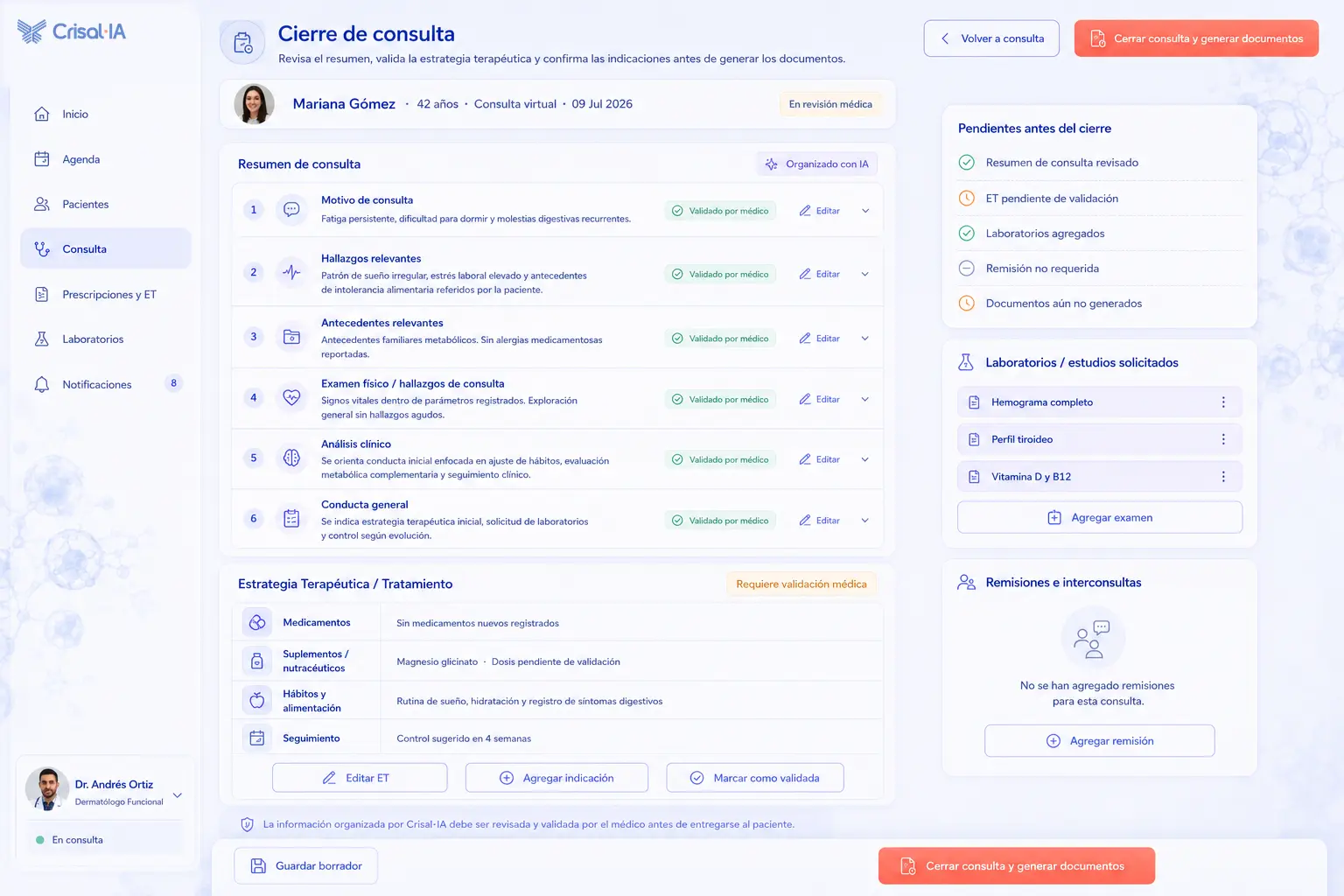 Open larger image ↗
An exploration of closeout to verify pending work, validate documents and preserve authorship before information reaches the patient.
Concept exploration · UX/Product direction · AI-assisted visualization08 / Tools
Tools tied to decisions.
- Figma
- Flows, wireframes, UI, prototypes and components.
- FigJam
- Interaction model, sources, validations and edge cases.
- ChatGPT + GenAI
- Case exploration, microcopy, variations and expected behavior.
- FAIR-AI
- Risk, transparency, human oversight and safe monitoring.
- Functional definition
- Rules, states, permissions, exceptions and handoff.
09 / Outcome
Verifiable design outcomes
An assistance model ready for responsible evaluation.
- A complete flow from capture through professional validation.
- Distinct states for source, generated content and confirmed decisions.
- Reusable patterns to review, correct, accept and discard.
- Traceability built into the experience rather than treated as a secondary feature.
- Error and uncertainty scenarios defined before implementation.
The product remains in development. These are design and definition outcomes; accuracy, time savings and safety must be verified through clinical validation and continuous monitoring.
What this case reinforced
In a clinical experience, trust does not come from making AI appear certain. It comes from making its limits visible and manageable.
The next stage should measure when assistance truly frees attention, where physicians need to return to the source and which suggestion types require stricter controls or should not be automated.
Next case
Therapeutic Strategy and Documents.
Turning a complex prescription into a clear, reviewable daily plan for the patient.