Many modules, roles and possible clinical scenarios.
← HealthTech product ecosystem
Case 01 · Product thinking · Prioritization
Turning a broad clinical vision into an MVP that can actually be built.
The HealthTech product needed to integrate consultations, clinical records, treatment, documents, follow-up and artificial intelligence. My challenge was to structure that vision as a system that was understandable, prioritized and feasible for a first version.
One platform, multiple moments of care
The vision was valuable, but it also contained too many possibilities for a first version.
The platform needed to serve patients, physicians and healthcare service organizations. Each role required different tasks, data and levels of responsibility, while the experience had to sustain continuity before, during and after the consultation.
The goal was not to simplify medicine, but to decide what the product needed to solve first and how to keep its parts connected without creating an architecture that was costly to learn and build.
02 / Problem
The central tension
If everything was a priority, the MVP stopped being an MVP.
Enough information without producing an overwhelming interface.
Integrating AI without presenting it as an automatic clinical decision.
Creating early value without building a complete enterprise operation.
Design questionWhat is the minimum architecture that enables a coherent clinical experience and provides a foundation for growth?
Personal contribution
I turned dispersed requirements into connected product decisions.
I organized modules, roles, relationships and entry points within a shared map.
I separated the essential MVP experience from capabilities intended for later stages.
I defined critical journeys and reusable patterns to reduce depth and learning effort.
I translated visual decisions into behaviors, states, permissions and implementation criteria.
I incorporated transparency, human oversight, consent and boundaries as product requirements.
The structural decision
A longitudinal experience with three levels of responsibility.
PatientUnderstands, prepares and maintains continuity.
PhysicianEvaluates, decides, validates and documents.
OrganizationCoordinates without interfering with clinical judgment.
How complexity was reduced
Four decisions with cross-product impact.
Organize around responsibilities
I separated the patient, physician and administrative experiences so each role received only the information and actions it needed.
Design for continuity
I connected preparation, consultation, treatment and follow-up as moments within one service rather than isolated modules.
Reduce navigation depth
We prioritized short journeys, contextual actions and modals so tasks could be completed without losing the clinical-case reference.
Define boundaries for AI
AI can organize, summarize and suggest. Clinical decisions, closure and signing remain under professional control.
Exploration for thinking and communication
A broad map made it possible to decide what should not enter the first version.
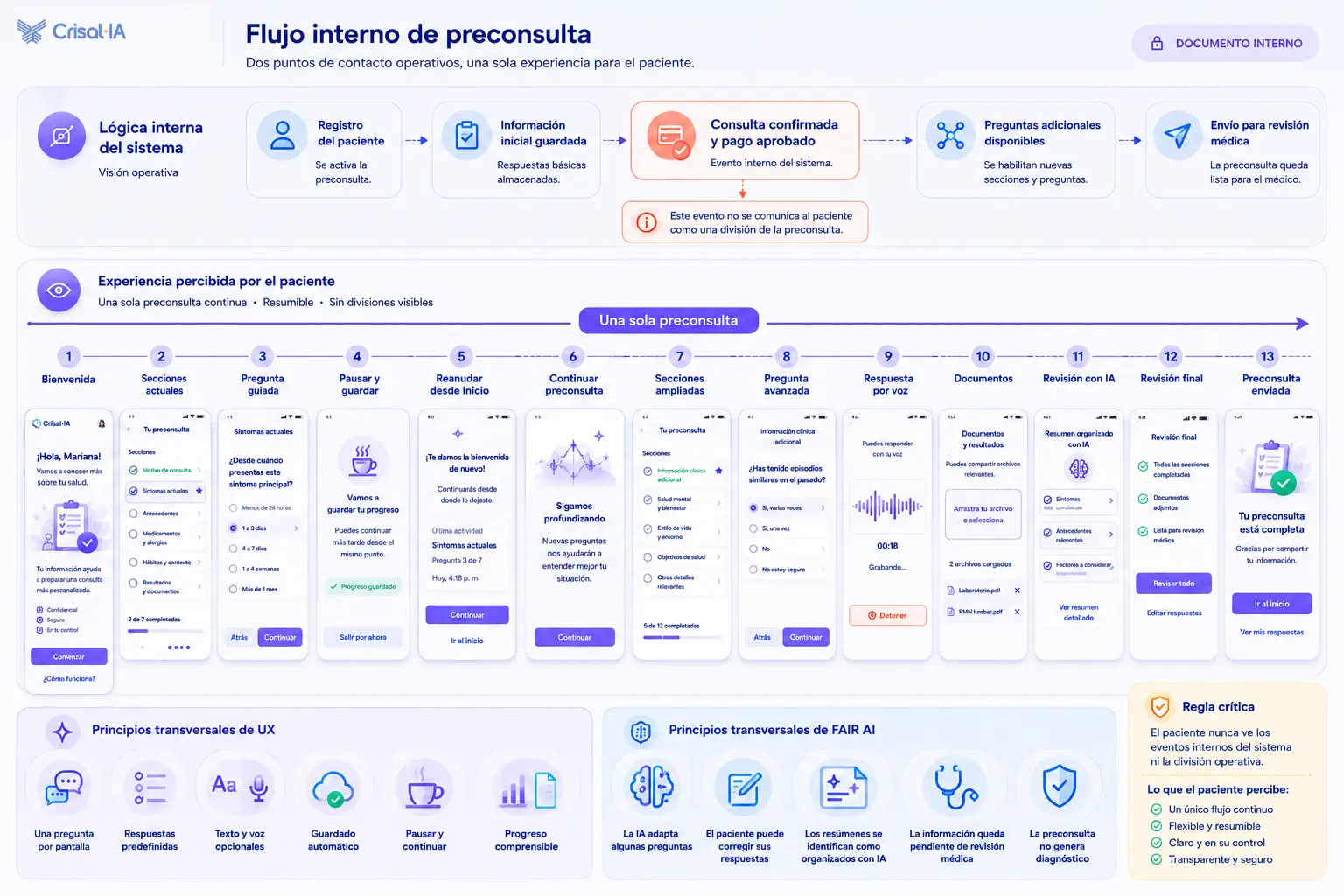
The exploration made the complete journey and its dependencies visible. Its value was not to define the final interface, but to provide a shared artifact from which the team could reduce scope while preserving a coherent longitudinal experience.
 Open larger image ↗
A visualization of the complete system used to compare breadth, dependencies and simplification opportunities before defining the MVP scope.
Concept exploration · UX/Product direction · AI-assisted visualization07 / Tools
Tools selected to support each decision.
- Figma
- Wireframes, interfaces, prototypes and components.
- FigJam
- Architecture, journeys and relationships between roles.
- ChatGPT + GenAI
- Exploration, documentation, critique and variations.
- Functional definition
- States, rules, permissions, exceptions and handoff.
08 / Outcome
Verifiable design outcomes
A coherent foundation for estimation, design and development.
- Architecture separated by roles and responsibilities.
- Connected journeys across the clinical service.
- Prioritized MVP scope without unnecessary operational complexity.
- Reusable patterns for forms, modals, states and documents.
- Criteria for AI transparency and human oversight.
The product remains in development. I present definition and design outcomes without attributing usage metrics that do not yet exist.
What this case reinforced
Designing an MVP is not about reducing features. It is about finding the minimum complete experience that produces value, preserves trust and enables learning.
In a later stage, these decisions should be tested with healthcare professionals and patients through critical-task testing, trust in AI suggestions and continuity between consultation and treatment.
Next case
End-to-end Patient Experience.
Connecting preparation, consultation, treatment and follow-up without overwhelming the patient.